
Product overview
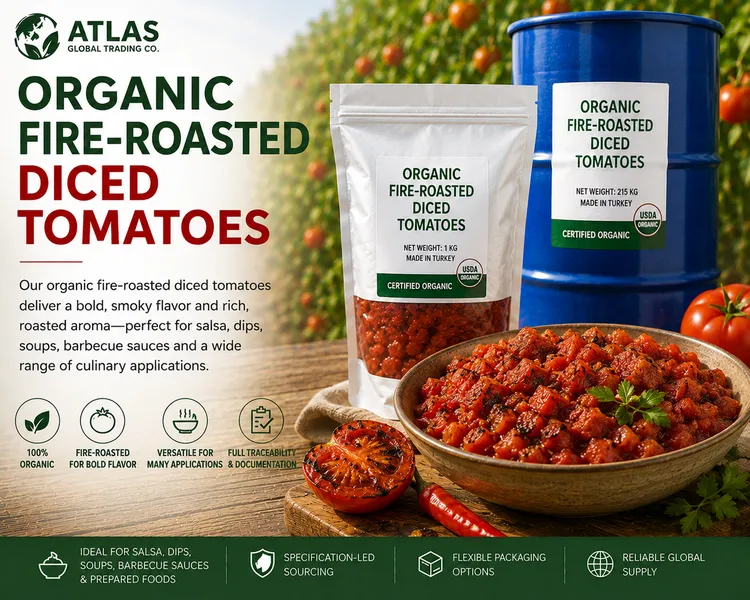
Organic fire-roasted diced tomatoes are tomato pieces processed under an organic supply program and exposed to a roasting step intended to develop browned or charred visual notes together with a deeper cooked tomato flavor. The diced format provides recognizable tomato texture while supporting relatively even distribution through commercial formulations.
This combination can be useful in salsa, dips, barbecue products, soups, sauces, prepared meals and foodservice recipes where a standard diced tomato may not provide enough roasted character on its own.
Atlas Global Trading Co. sources tomato ingredients through a multi-origin network of farms, processors and supply partners. We match the ingredient to the customer’s required organic certification, cut size, roast profile, packing medium, texture, technical documentation, destination and supply program.
Specification focus
Dice size is an important purchasing parameter because it affects visual identity, mouthfeel, portioning and how evenly tomato pieces distribute through the finished food. Buyers may also specify tolerances for broken, undersized or oversized pieces where consistency is important.
Roast level and roasted appearance should be confirmed for the selected product program. Commercial products can differ in the amount of visible roast marking and in the intensity of roasted flavor, so samples are useful where sensory profile is central to the finished product.
Packing medium should also be defined. Depending on the processor and product configuration, diced tomatoes may be supplied in juice, puree or another approved tomato-based medium. The selected medium can influence drained weight, flavor balance, recipe water contribution and finished consistency.
Color, pH, acidity, texture, piece integrity and microbiological limits may also form part of the approved specification. These parameters should be aligned with the customer's formulation and downstream thermal process.
Roasted flavor and appearance
Fire-roasted tomatoes can contribute cooked, browned and slightly smoky sensory notes depending on the selected processor and roast profile. This can help add flavor complexity to products that would otherwise depend on extended cooking or additional roasted ingredients.
Visible roast marks may also contribute to product identity in salsa, dips and premium sauces. Because roast appearance can vary naturally, buyers with tight visual targets should define their acceptable range and review representative samples.
Texture and piece integrity
The diced pieces should be evaluated not only on incoming cut size but also on how well they retain shape during mixing, pumping, filling and thermal processing. Softer products may integrate more readily into sauces, while firmer dice can remain more visible in salsa and prepared meals.
Where piece identity matters, manufacturers should consider mixing intensity, pump design and process time. Excessive shear can reduce the proportion of recognizable dice in the finished product.
Pilot or plant trials are useful when a new processor, dice size or roast profile is introduced.
Application behavior
In salsa and dips, fire-roasted diced tomatoes can provide visible tomato structure together with roasted flavor. The packing medium, drained solids and final mixing process influence whether the finished product is chunky, spoonable or more sauce-like.
In soups, barbecue sauces and prepared meals, the pieces may soften further during thermal processing and contribute flavor to the surrounding liquid phase. Manufacturers should evaluate the product after the complete process rather than only in its incoming state.
Typical applications
- Organic salsa and chunky tomato dips
- Barbecue sauces and smoky savory sauces
- Soups, stews and culinary bases
- Prepared meals and ready-to-eat foods
- Pizza, pasta and Mexican-style formulations
- Foodservice and premium private-label products
Packaging and handling
Organic fire-roasted diced tomatoes may be available in aseptic, canned, pouch, foodservice or other industrial formats depending on the processor and product program. Pack choice should be matched to the receiving plant, annual volume and intended storage system.
Buyers should confirm net weight, drained weight where relevant, packing medium, liner or container configuration, palletization, shelf life and storage conditions. Receiving teams should also verify package integrity and lot identification before production use.
Organic program controls
Organic certification is a core part of the product specification. We confirm certification scope and supporting documentation for the selected processor, origin and supply lot, including relevant chain-of-custody records where applicable.
Buyers should provide the destination market and any customer-specific organic requirements during inquiry. Packing medium and any additional formulation inputs should also be reviewed to ensure alignment with the intended organic program and final ingredient declaration.
Final organic claims should remain aligned with the approved product, processor certification, supply documentation and destination-market requirements.