
Product overview
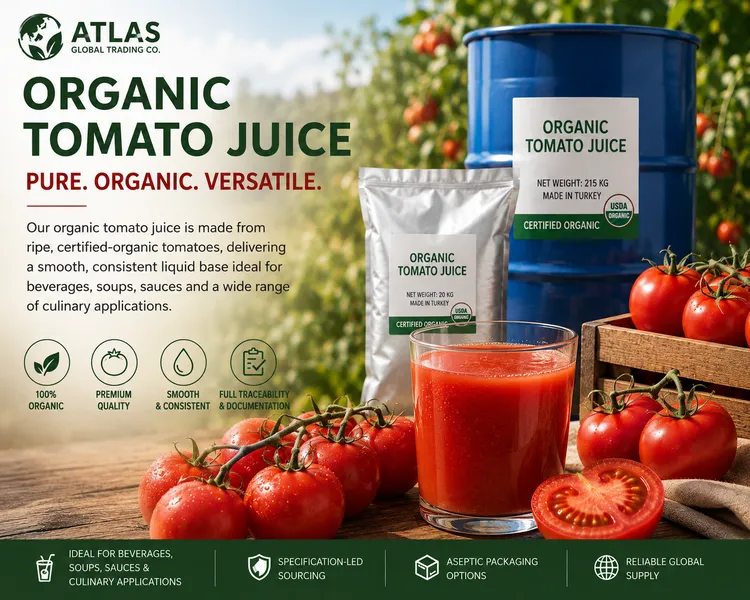
Organic tomato juice is a liquid tomato ingredient produced from certified-organic tomatoes for beverage, soup, sauce and prepared-food manufacturing. Compared with tomato puree or paste, juice provides a more dilute tomato base and can therefore reduce the amount of reconstitution required in applications that already need a substantial liquid phase.
Depending on the selected processor and commercial program, organic tomato juice can vary in soluble solids, pulp content, salt, acidity, finish and packaging. These characteristics influence both sensory quality and processing behavior in the finished application.
Atlas Global Trading Co. sources tomato ingredients through a multi-origin network of farms, processors and supply partners. We match the ingredient to the customer’s required organic certification, finished-product performance, commercial pack format, technical documentation, destination and supply program.
Specification focus
Soluble solids or Brix are useful indicators of tomato concentration and should be confirmed as part of the commercial specification where relevant. A buyer using juice as a beverage base may prioritize a different solids profile from a manufacturer using it as an ingredient in soup or sauce.
Pulp content and finish can influence mouthfeel, visual appearance and sedimentation. A smoother juice may be preferred for certain beverage or blending applications, while a product retaining more fine tomato pulp can provide a fuller or more natural tomato texture.
Salt should be specified rather than assumed. Depending on the supply program, tomato juice may be offered with different salt conditions, and this can materially affect downstream formulation in beverages, soups, sauces and prepared foods.
Color, pH, acidity, flavor and microbiological parameters may also form part of the approved specification. Buyers should align these parameters with the intended processing method, finished taste profile and customer-specific quality requirements.
Beverage and blend performance
In beverage applications, manufacturers may evaluate tomato flavor, color, salt balance, pulp level and mouthfeel alongside physical stability. The interaction between tomato juice and other vegetable juices, seasonings, acids or flavors can change the final sensory profile.
For blended products, bench or pilot trials can help confirm the desired balance of tomato character and overall drinkability before a commercial source is approved.
Soup and culinary applications
Organic tomato juice can provide both liquid and tomato solids in soups, sauces, braising systems and other culinary formulations. This may simplify recipes that would otherwise require separate additions of concentrated paste and water.
During cooking, evaporation and interaction with starches, vegetables, proteins or other ingredients can change the apparent viscosity and flavor intensity. Manufacturers should therefore evaluate the juice in the complete recipe rather than on incoming consistency alone.
Juice versus puree or paste
Juice generally provides the lowest concentration and highest water contribution of the common liquid tomato ingredient formats on this site. Puree can offer greater body and tomato solids, while paste is selected when manufacturers need a much more concentrated source of tomato solids.
The most suitable option depends on recipe water balance, desired texture, plant handling, freight economics and how much concentration or dilution will occur during production.
Typical applications
- Organic tomato and vegetable beverages
- Soups and soup bases
- Sauces and culinary preparations
- Vegetable and savory blends
- Prepared foods and ready meals
- Foodservice and institutional kitchens
Packaging and handling
Industrial organic tomato juice may be supplied in aseptic drums, larger bulk containers or other processor-approved configurations. Selected foodservice or retail formats may also be possible depending on the commercial program.
Receiving teams should verify package integrity, lot identification, storage instructions and shelf-life documentation. Where aseptic packaging is used, unloading and transfer equipment should be suitable for the selected pack configuration and plant process.
Organic program controls
Organic certification is a core part of the product specification. We confirm certification scope and supporting records for the selected processor, origin and supply lot, including relevant chain-of-custody documentation where applicable.
Buyers should provide the destination country and any customer-specific organic requirements because accepted certification and labeling pathways can differ by market and supply program.
Final organic claims should remain aligned with the approved product, certification scope, processor documentation and destination-market requirements.